

Angle

Leverage Intelligent Platforms To Reduce Investigation Cycle Time
- Regulatory and Compliance
Key Takeaway: Although leading compliance teams are closing cases faster, prompt closures are never guaranteed. Delayed case closures aren’t just frustrating; they can jeopardise the integrity of the investigation. Compliance teams gain speed and confidence with intelligent, integrated platforms that eliminate bottlenecks by automating data collection and accelerating analysis without sacrificing rigour.
For compliance departments, intensifying regulatory demands and persistent resource constraints have made the stakes and expectations higher than ever. The mandate is clear: deliver more value without compromising risk tolerance.
Many programmes are meeting these demands by outsourcing, offshoring, adopting new technology platforms, using AI, or combining these approaches. Nevertheless, investigations remain a stubborn challenge for compliance teams. One critical indicator of compliance programmes’ efficiency and effectiveness, investigation case cycle time (the period from when a report is received to its final resolution), has proven resistant to reduction.
Where Investigations Lose Time
For compliance leaders striving to deliver timely, thorough, and defensible outcomes, reducing case-closure time remains a formidable hurdle. AI tools limit distractions and disruptions that often derail progress, keeping investigations focused and efficient. Yet, as many teams have discovered, several obstacles slow progress and extend case closure times beyond initial expectations. Respondents to the CaseIQ 2025 Investigative Case Management Benchmark Report identified seven bottlenecks, with ‘gathering evidence’ and ‘lack of resources and staff’ emerging as the most common impediments.
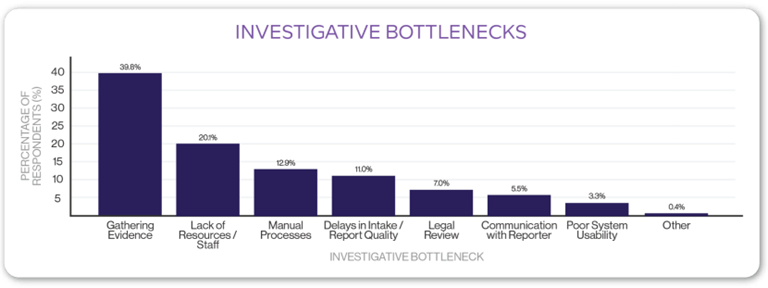 CaseIQ 2025 Investigative Case Management Benchmark Report
These bottlenecks persist despite the added support of technological advancements. Compliance firm NAVEX’s published case closure time benchmarks from 2020 through 2025 reveal that while there have been periods of meaningful progress, various friction points within the investigation lifecycle have endured.
These bottlenecks suggest that, even as organisations innovate and adapt, certain aspects of the investigative process are inherently difficult to streamline. A closer examination of the components of the investigative process illuminates the challenges.
Collection
Necessary approvals, requests to multiple data owners, and limited internal resources delay the gathering of relevant information. These delays often compound when data requests span multiple departments or jurisdictions, requiring coordination across teams that may have competing priorities or limited availability. For some data sources, such as pictures and PDFs, collection efforts lag due to the need for processing or conversion into usable formats. Obtaining data from mobile devices also extends timelines. Centralising evidence in a single platform removes these hurdles and enables faster intake.
Analysis
Without a highly detailed whistleblower report, investigators must rely on basic keyword searches to identify potentially responsive documents. Transactional data, such as invoices, receipts, or purchase orders, is often in PDF format, requiring time-consuming and resource-intensive individual review and manual summarisation.
Without advanced analytical tools or automation, investigators often spend countless hours sifting through disparate datasets, trying to piece together a coherent chronology and narrative. This manual approach increases the risk of missing critical information that could impact the outcome of the investigation.
Interview Preparation
Managing and synthesising responsive documents adds an additional layer of complexity. Some investigators print documents to organise them manually; others juggle multiple windows and spreadsheets to extract key facts. Tools like Copilot and ChatGPT show what fast summarisation and synthesis could look like, and those capabilities become practical and secure when they are built into controlled investigation platforms where confidentiality and defensibility are protected.
The Compounding Effect of Interviews
Compared to collection and analysis, tasks like scheduling interviews, summarising discussions, and drafting investigation reports are usually straightforward and proceed quickly. Yet interviews rarely mark the end of the investigative process. They often surface new facts, inconsistencies, or leads that require additional data gathering and validation. This iterative cycle (collect, analyse, interview, repeat) prolongs case closure timelines, even for matters that appear simple. These dynamics underscore a core tension facing compliance teams today: balancing speed with rigour, confidentiality, and defensibility.
Balance Speed and Rigour in Compliance Investigations
Moving faster requires rethinking the entire investigative workflow. The bottleneck often begins in the earliest phases, when fragmented data sources and manual processes slow momentum.
To break this cycle, organisations need strategies that simultaneously streamline data intake while accelerating synthesis, without compromising quality. That requires leveraging technology to centralise information, applying advanced analytics to surface patterns early, and creating frameworks that enable investigators to pivot quickly as new details emerge. By modernising early‑stage workflows and centralising information, teams remove friction and gain the visibility they need to move faster with confidence. These updates give investigators a clear path through complex matters and create momentum that carries through the rest of the case.
Turn Bottlenecks Into Breakthroughs: Why Intelligent Platforms Matter
Reducing case closure time isn’t easy to fix on your own. Manual collection and normalisation often take days or weeks, creating friction that slows each subsequent step. When evidence is accessible in one place, investigators shift from chasing data to advancing the investigation. This creates a more predictable and efficient process that strengthens both speed and defensibility.
This is where the right partner makes a difference. Intelligent platforms equipped with built-in integrations and APIs connect directly to primary data repositories, eliminating silos and accelerating evidence gathering. By automating data intake and enabling real-time access to relevant information, these solutions allow compliance professionals to focus on analysis and decision-making rather than chasing documents.
Beyond speed, these platforms enhance defensibility and confidentiality by applying consistent protocols across all data sources. They also support advanced analytics and collaboration tools, helping teams surface insights earlier and respond dynamically as new details emerge. The result is an investigation that advances with precision, transparency, and confidence, without sacrificing rigour.
Closing the Gap
Timely investigations do more than demonstrate organisational integrity; they also reinforce confidence in the compliance programme itself. The moment an escalation is received, every stakeholder, from employees to management and even regulators, expects swift action, thorough analysis, and resolution that addresses the matter at hand and closes potential control gaps.
By leveraging platforms that unify data sources, automate collection, and enable real-time collaboration, compliance teams move beyond bottlenecks and toward fast, defensible, and secure outcomes. The right partner delivers confidence that your investigation is handled with rigour, confidentiality, and efficiency. As a result, compliance teams position themselves for sustained success and a stronger, more resilient programme.
Learn more about Epiq Compliance Advisory and Technology.

Jerry Kral, Compliance Advisory Leader
At Epiq, Jerry Kral leads the Compliance Advisory and Technology Practice, based out of the Epiq Chicago office.
For over 25 years, Jerry has served as a trusted advisor to General Counsel and Chief Compliance Officers, helping establish, enhance, and optimise risk-based compliance programmes and infrastructure.
The contents of this article are intended to convey general information only and not to provide legal advice or opinions.