

Angle

AI Hygiene vs. AI Governance: What Legal Teams Need To Know
- Information governance
- 3 Mins
Key Takeaway: Preparing data for AI is integral to successful adoption, but responsible implementation requires clear expectations for how people instruct AI and evaluate its outputs, as well as apply its recommendations. Good AI hygiene connects prompting practices to approved business purposes and appropriate controls with communications compliance monitoring to identify risky AI usage. The prompt communicates the task. Governance, training, technical controls, and monitoring establish and reinforce the rules.
Your Data Is Ready. Are Your AI Interactions?
Inadequate governance frameworks are rarely to blame for AI failures. Missteps occur when employees interact with AI in ways that prevent successful governance. The risk is not limited to what an employee intentionally puts into a prompt. It also includes the context, content, and embedded instructions the AI brings into the interaction.
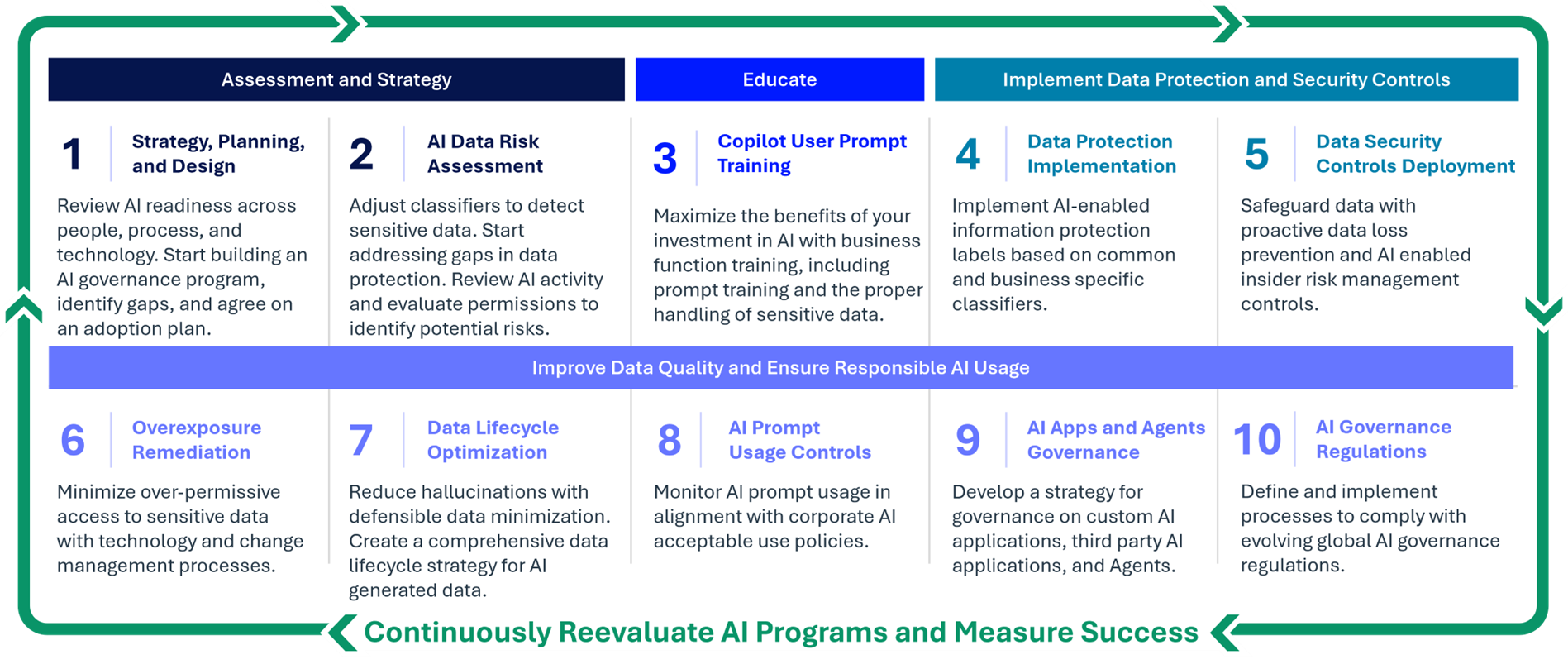
The Difference Between AI Governance and AI Hygiene
While AI governance and AI hygiene are related, they are not the same.
AI governance establishes policies and controls, as well as accountability structures and oversight mechanisms that define how an organization should use AI. AI hygiene is the day-to-day application of those requirements by employees using AI systems.
It is critical to note this difference. Governance establishes expectations, but AI hygiene determines whether those expectations are consistently followed in practice.
Why Does AI Hygiene Matter for Legal Teams?
AI capabilities are expanding from simple chat interfaces to agents that perform tasks while accessing information and interacting with business systems. With strong hygiene, AI remains a tool that supports human decision-making rather than a substitute for accountability.
Four Common Risks of Poor AI Hygiene
Risky AI usage can expose organizations to information, reasoning, instruction, and authority risks. This includes sharing sensitive information to relying on inaccurate outputs or allowing AI to act beyond authorized boundaries.
Authority Risk: AI can support decisions, but designated individuals retain authority and accountability for approvals, judgments, and outcomes.
Information Risk: Employees remain accountable for what information AI can access, applying safeguards and restrictions to sensitive, confidential, privileged, regulated, or proprietary content.
Reasoning Risk: AI outputs may appear authoritative despite errors, omissions, or missing context. Additionally, generative AI systems may infer or reveal sensitive information beyond what was intentionally provided.
Instruction Risk: AI may act on more instructions than the user can see, including prior conversation history, retrieved content, connected sources, and commands embedded in documents.
Build Better AI Hygiene
Organizations often associate AI proficiency with prompt engineering. Effective prompting improves results, but good AI hygiene is fundamentally about responsible behavior.
It is critical to understand that the prompt is bigger than the prompt box. An AI system’s context window may include instructions embedded within documents. An employee can therefore write a careful prompt and still receive an output shaped by irrelevant, outdated, or malicious context.
Templates make the intended operating boundaries explicit and give users a consistent way to recognize when retrieved content is attempting to redirect the task.
Monitor Risky AI Usage
Hygiene expectations only gain traction if organizations can evidence whether they are followed. Transparency is key to enable legal and compliance teams to monitor for risky AI usage without relying on employees to self-report. Solutions such as Microsoft Purview Communication Compliance analyze AI prompts and responses for sensitive or confidential information, inappropriate content, and attempts to manipulate the AI, including prompt injection.
This monitoring empowers teams to put data hygiene into practice. Flagged interactions are routed to designated reviewers, which creates an auditable record and highlights where training, templates, or controls need to improve. Privacy safeguards, such as anonymous usernames and role-based reviewer access, equip organizations to balance oversight with employee trust.
Communication compliance should evolve alongside AI adoption. Transitioning from Microsoft 365 Copilot to agents through Agent 365, Microsoft Foundry, Copilot Studio, and other AI technologies, the number and types of interactions requiring oversight expand considerably.
The adoption of AI agents is expanding daily, including those built through internal launchpads such as Microsoft Foundry and Copilot Studio. This significantly increases the number of interactions requiring oversight.
Establishing monitoring requirements now and adopting enterprise-wide governance practices are the key to data hygiene. Ultimately, policies, reviewer workflows, and escalation paths will scale alongside each new tool and evolving provider capabilities.
Why AI Governance Alone Is Not Enough
Use this test as a reference for legal teams to consider before expanding AI use. Ask whether employees know:
- What information they may share
- Which AI tools and sources they may use
- What outputs they must verify
- Which decisions require human approval
- When they must stop and escalate
If users cannot answer those questions consistently, the organization has an AI hygiene gap even if its governance framework is mature.
Now more than ever before, teams need visibility into how AI is being used. Communication compliance provides that additional layer of oversight. With proper structures in place, organizations spot risky interactions and adapt controls as their use of AI inevitably changes.
Learn more about Epiq Information Governance Advisory.

Stephen Clements, Director, AI Governance
Stephen Clements partners with organizations to establish strategic governance frameworks that enable the responsible adoption of AI and emerging technologies. He advises clients on AI governance, risk management, and regulatory readiness, as well as privacy, security, and operational oversight. His support equips organizations to balance innovation with accountability and trust.

Carlos Espinoza, Director, Information Governance
Carlos Espinoza advances strategies for clients that improve data management and strengthen compliance while reducing enterprise risk when using AI and agents. He brings more than three decades of experience in information governance, cybersecurity, cloud security, technology risk, and enterprise IT leadership to his role at Epiq.
The contents of this article are intended to convey general information only and not to provide legal advice or opinions.