


Implement Data Protection in the Age of AI for Responsible Governance
- Information governance
- 1 min
Key Takeaway: Sensitivity labels and intelligent classifiers are the backbone of responsible AI governance. They automate the discovery and protection of sensitive data at scale, minimise human error, and accelerate compliance. Combined with dynamic proactive policies, they safeguard information across channels, reduce risk, and uphold regulatory standards. Start with discovery and a phased rollout for high risk areas; evolve governance with technology.
AI is reshaping business operations at lightning speed, and organisations are racing to keep pace. Tools like Copilot promise efficiency and cost savings, but they also introduce new risks. At the centre of these risks is your most sensitive data.
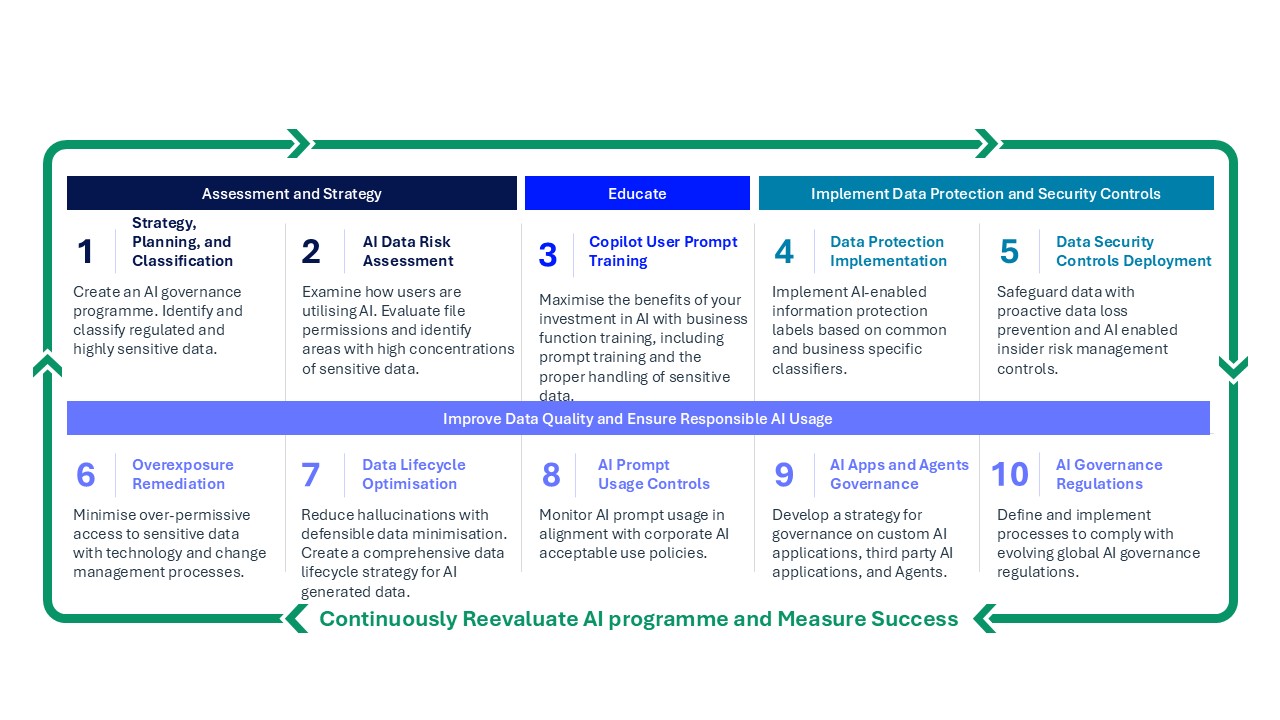
Embarking on the journey to responsible AI adoption requires a clear roadmap. The 10-step Copilot Readiness framework is designed to guide organisations through each critical phase of deploying Copilot securely and effectively. After step three, educating your team with Business Function-Specific Prompt Training, step four focuses on an essential consideration: building a strategic data protection framework. This goes beyond meeting compliance requirements. It’s about earning trust, driving ethical AI practices, and building a resilient organisation that can adapt and thrive.
Understanding Classifiers and Sensitivity Labels: The Backbone of Modern Data Protection
As organisations embrace AI and cloud-powered collaboration tools, protecting sensitive information has become more challenging and more critical than ever before. But where do you start when strengthening your data protection posture? The answer lies in ‘knowing your data’ with the help of intelligent classifiers and sensitivity labels.
What are classifiers and why do they matter?
Imagine sorting through mountains of documents, emails, and chats that contain both harmless updates and confidential client details, regulatory data, or Personally Identifiable information (PII). Classifiers are intelligent assistants that do this sorting for you. They automatically identify and categorise content based on its context or unique patterns. This ensures that sensitive information is never left unmonitored, and classification stays with files wherever they go.
With Microsoft purview, you’re not limited to rigid rules. Advanced trainable classifiers harness the power of AI to understand concepts in unstructured text, so even if data doesn’t follow a predictable template, it’s still recognised and protected. Whether you’re using prebuilt classifiers or crafting your own, they adapt to your organisation's needs.
Sensitive Information Types (SITs) use pattern-matching and document fingerprinting to accurately identify and secure regulated data. When you need pinpoint precision, Exact Data Match (EDM) ensures business identifiers match only the correct records, reducing false alarms and keeping your data protection efforts focused. These classifiers may be trained using feedback mechanisms and subsequently fine-tuned as needed.
Unlock the Power of Sensitivity Labels
Classifying information is only the first step. The true strength of a security framework lies in acting upon those classifications. Sensitivity labels serve as digital markers that accompany your files, emails, and collaboration spaces. They indicate how each item should be labelled, be it ‘Public,’ ‘Internal,’ ‘Confidential,’ or ‘Restricted’ in accordance with your organisation’s standards and regulatory requirements. These include frameworks such as HIPAA, GDPR, India’s DPDP Act, or any industry-specific compliance mandates. This ensures that sensitivity labels are relevant for every sector, including education, healthcare, manufacturing, retail, finance, technology, and government.
Microsoft Purview enables automatic or manual labelling of data across platforms like SharePoint, OneDrive, Outlook, and Teams, applying protections instantly. Simulation modes help test policies safely, while on-demand scans ensure older files are also secured. This automation is crucial in today’s fast-paced AI environment.
Sensitivity labels are not just visual indicators; they enable enforcement of Data Loss Prevention (DLP) controls, extend protection to Windows devices and embedded file types, and help manage access within collaboration spaces such as Teams and SharePoint without hindering productivity or collaboration. In AI data protection scenarios, including Copilot and Azure AI Search, these labels provide an additional layer of defence, ensuring sensitive information remains secure even as teams leverage advanced technologies. Together, classifiers and labels form the backbone of an information governance strategy, allowing organisations to automate the classification and safeguarding of data at scale.
Step-by-Step Guide to Implementing AI Data Protection
Step One: Discover
Assess AI Usage by identifying all AI tools and integrations in use across your organisation. Use Microsoft Purview Data Security Posture Management (DSPM) to monitor data flows and uncover exposure risks. Document high-risk scenarios, such as AI prompts attempting to access sensitive data.
Step Two: Protect
Define your labelling strategy by creating a sensitivity label taxonomy (e.g., Public, Internal, Confidential, and Restricted) that aligns with compliance requirements and organisational needs. Configure policy tips to guide users during manual labelling.
Enable auto-labelling for service-side policies for SharePoint, OneDrive, and Exchange to classify data at rest. Use simulation mode to validate coverage and extend labelling to Teams, Groups, and Sites.
Step Three: Prioritise
Configure AI DLP policies that reference sensitivity labels to monitor and control data movement. Start in audit-only mode to gather insights, then gradually enforce restrictions on uploads, browser actions, and AI prompts.
Step Four: Govern
Ensure continuous monitoring and optimization by reviewing compliance reports and assessments in Microsoft Purview to measure effectiveness. Adjust classifiers and labels based on feedback. Expand coverage to endpoints and integrate with AI services like Copilot and Azure AI search for label-based access control.
Foundational Requirements for AI Data Protection
Effective AI data protection requires ongoing monitoring along with clear employee education to ensure compliance and smooth adoption. Utilise the four approaches above as your foundation. The timeline for implementing data protection varies depending on the size and readiness of your organisation, starting with high-risk areas, and using early detection tools to gain insights and reduce risk even before full deployment.
Responsible AI Governance Starts With Data
Implementing data protection in the age of AI is a strategic imperative that demands foresight, flexibility, and a commitment to responsible governance.
If your sensitive information isn’t fully protected, don’t panic; start acting. Begin by assessing where your data resides and how it’s being used. Then, implement a framework that combines discovery, classification, and proactive policies.
Look for a partner with proven expertise in AI governance and compliance. A trusted provider will help you automate protection at scale and guide you through phased rollouts, ensuring a seamless process. The right support ensures your organisation not only meets regulatory standards but also builds trust and resilience for the future.
Learn more about Epiq Responsible AI and Copilot Readiness.

Jon Kessler, Vice President and General Manager, Information Governance
As Vice President and General Manager of Information Governance within Legal Solutions at Epiq, Jon leads a global team focused on helping clients unlock the value of Microsoft Purview through Responsible AI and Copilot Readiness services. Under his leadership, the team has been recognised as the Microsoft Compliance Partner of the Year in 2023 and as a finalist in 2022, 2024, and 2025.

Swapnil Sawant, Senior Data Security Specialist, Information Governance
Swapnil is an experienced Information Security professional with over ten years in advisory, product, manufacturing, and banking industries. He specialises in AI data protection and assists organisations in developing strategies for evolving customer needs.
The contents of this article are intended to convey general information only and not to provide legal advice or opinions.