

Angle
-(1).png)
Overexposure Remediation: Turning Access Risk Into Ongoing Control
- Information governance
Key Takeaway: Copilot doesn’t create new access; it accelerates the impact of the access your environment already grants. Step six of the ten-step Copilot readiness series focuses on effective access: identifying where sensitive content is accessible beyond intended use, prioritizing the highest-risk paths, and applying targeted fixes so exposure trends down and stays down.
By the time most organizations reach step six of the ten-step Copilot readiness program, they’ve done a lot of the right groundwork. They’ve discussed classification, rolled out sensitivity labels, and begun setting expectations for what Copilot should, and shouldn’t, be able to surface. This is where planning meets the day-to-day reality.
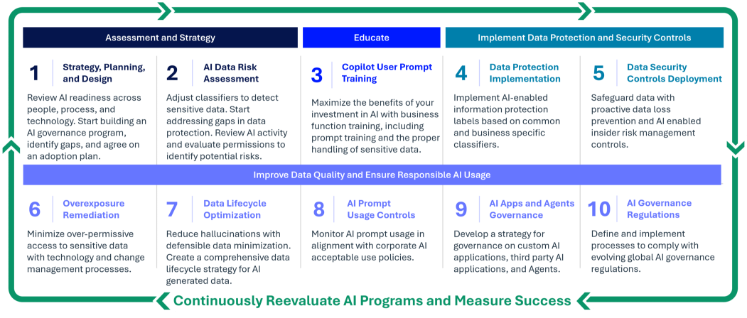
Years of collaboration, such as shared links, open SharePoint sites, inherited permissions, and group and Teams sprawls, tend to accumulate quietly. Then Copilot arrives and does what it’s designed to do: it finds information the user can reach and quickly surfaces it. As a result, overexposure becomes an access control reality.
Where SharePoint Advanced Management Fits
In many Microsoft 365 environments, a majority of Copilot’s “effective access” exposure stems from SharePoint (site visibility, membership sprawl, external sharing, and unmanaged content locations). Data Security Posture Management (DSPM) identifies and prioritizes the locations and access paths driving overexposure.
SharePoint Advanced Management can be used to apply and maintain consistent SharePoint configuration and sharing controls across sites at scale. In practice, the workflow identifies the locations driving exposure, implements controls, and rechecks regularly to confirm exposure is decreasing.
Data Security Posture Management Makes Access Risk Measurable Over Time
Readiness efforts often stall when they’re treated like a one-and-done project. Overexposure remediation supports a critical, ongoing mindset as permissions and content change every day.
As a result, ongoing data oversight becomes manageable with insight into sensitive data locations, access patterns that exceed policy, and environments where intelligent discovery is likely to introduce new exposure.
This practice reduces risk and demonstrates a decline in exposure over time, not just after a single cleanup.
Overexposure Is an Access Problem
Overexposure often comes from access people don’t realize they have, and Copilot can surface content from any of it. This approach brings the discussion back to effective access, not just what the policy intended. Put simply, it helps you answer the most important Copilot question:
“What can users reach right now, and what could Copilot pull into an answer because of that?”
That reframes this step from a generic “permissions cleanup” to a measurable and concrete reduction of Copilot exposure.
Address the Most Critical Remediation
Don’t try to assess and remediate the whole enterprise in one pass. Break the work into manageable segments, such as HR, executive spaces, and shared collaboration areas. Each segment has different sensitivity, sharing patterns, and risk tolerance.
Prioritize the places where overexposure is most likely to create Copilot risk and run remediation as a disciplined program instead of an endless backlog. Instead of “we have a million findings,” the story becomes:
- Here are the top exposure hotspots that matter for Copilot”
- “Here’s what we’ve remediated”
- “Here’s what’s trending in the right direction”
- “Here’s where we still need business signoff”
This narrative gives stakeholders the clarity they need.
The Value Lies Not Only in Security, but in Quality Too
Overexposure remediation is also where you start improving the quality of Copilot outputs by grounding it in cleaner, more reliable, and appropriately accessible data.
Even when security is the driver, teams also care about operational outcomes: fewer surprise results, fewer escalations to Legal or HR, and greater confidence that Copilot won’t surface inappropriate content in the wrong context.
DSPM is one way to connect those dots:
- Reduce overexposure to reduce risk.
- Reduce overexposure to improve answer reliability.
- Improve reliability to increase trust and adoption.
Make Governance Operational and Sustainable
Automation is essential, but judgment still matters. This is especially true in gray areas or where regulatory nuance applies. Teams use it well by pointing attention to the places that warrant it: high-risk data, unclear ownership, justified exceptions that need business context, and decisions you may need to defend later.
The following framework brings these considerations into a practical playbook:
- Scope: Pick a bounded area (e.g., HR, executive sites, a shared collaboration hub) and define what “intended access” means for that area.
- Find: Identify sensitive content and the specific access paths Copilot can traverse (sites, links, groups and Teams membership, and inherited permissions).
- Fix: Remediate the highest-impact issues first (reduce broad membership, correct overshared links, right-size site permissions). Use SharePoint Advanced Management to apply consistent sharing and configuration settings where scale is required.
- Validate: Document and obtain owner sign-off for justified exceptions and gray areas.
- Monitor: Recheck on a regular cadence and report trends so exposure stays down as collaboration changes.
Overexposure Remediation Is Where Readiness Becomes Reality
Strategic preparation, business-function-specific prompt training, data risk assessments, data classification, and classification-driven protections clear a path to safely begin using Copilot. Overexposure remediation turns that path into a structured operating environment. The data Copilot uses becomes more reliable, appropriately accessible, and continuously validated as sharing and access settings are kept consistent over time.
Learn more about Responsible AI and Copilot Readiness.

Paul Renehan, Vice President, Advisory
Paul Renehan is an executive leader with more than two decades of experience spanning data governance, information protection, and eDiscovery, with a growing focus on preparing organizations for the accelerating demands of artificial intelligence. As Vice President, Advisory, he leads a team of specialists who modernize enterprise data governance and protection strategies, ensuring information ecosystems are secure, compliant, prepared for AI, and positioned to drive business value.

David Smythe, Senior Manager, Data Lifecycle Management
David helps organizations reduce risk and improve business performance by strengthening the governance, quality, and lifecycle management of their information and data assets. He advises clients on developing actionable governance frameworks, implementing policies and processes, improving data hygiene and classification, and establishing metrics that support defensible and efficient data practices.