

Angle
.png)
Optimize Data Lifecycle Management To Improve AI Outcomes and Reduce Risk
- 3 mins
Key Takeaway: Organizations cannot achieve trustworthy AI with poor data quality or poorly organized information. By systematically reducing redundant, obsolete, or trivial (ROT) data, applying defensible retention and disposition policies, strengthening information architecture, and governing AI content, organizations create a cleaner data environment that produces more accurate AI outputs, lowers risk, and supports responsible AI adoption at scale.
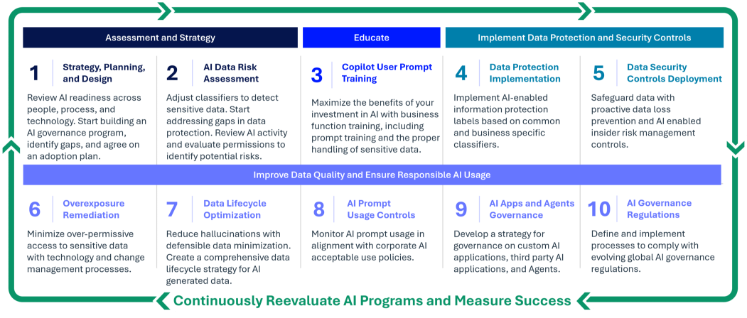
As organizations advance through the responsible AI readiness journey, each step builds toward the same objective: ensuring AI is supported by trusted, secure, compliant, and well-governed information.
Generative AI tools are only as useful as the data they can access, and the quality of that data directly impacts outcomes. The responsible AI readiness journey starts with careful and intentional AI implementation. Step seven in the 10-step program focuses on a practical level that organizations can control: data lifecycle management.
The objective is twofold. First, improve AI results by reducing low-value or outdated content. Second, reduce risk by consistently and defensibly applying retention and disposition policies to content, including data that AI tools generate.
Why Data Lifecycle Management Directly Impacts AI Accuracy
Retention has traditionally been treated as a compliance requirement. However, when data is retained indefinitely or applied inconsistently, organizations incur measurable cost and risk. Excess data increases storage cost, complicates discovery, and worsens the signal-to-noise ratio when users and AI systems attempt to retrieve relevant information.
Poor data quality also contributes to weaker AI outputs. When outdated, redundant, or trivial content dominates the dataset, AI tools are more likely to surface irrelevant or misleading information. This dynamic introduces risk in decision-making, regulatory response, and litigation exposure.
A mature data lifecycle management program changes this equation. It enables organizations to retain what is required, dispose of what is no longer needed, and maintain access to high-quality, relevant content. This allows organizations to meet compliance requirements while improving AI performance.
What Lifecycle Optimization Looks Like in Practice
Data lifecycle management is an ongoing, operating discipline that spans the full lifecycle of information, including creation, storage, use, retention, archiving, and deletion. Effective programs improve integrity, security, compliance, and operational efficiency by embedding retention and disposition into daily operations.
A practical lifecycle program typically includes:
- Governance: Define roles, decision rights, and policy standards to align legal, regulatory, and business requirements.
- Inventory: Visibility into what data exists, where it resides, and which content is sensitive or regulated.
- Retention: Clear, enforceable rules to apply consistently across systems and content types.
- Auditability: Ongoing reporting to confirm teams apply policies, manage exceptions, and ensure defensible disposal actions.
- Automation: Automation of lifecycle policies to reduce reliance on end users to manage records manually and support consistent adoption.
Information Architecture: Organizing Data for AI Readiness
Information architecture strengthens AI readiness by ensuring retained data is centralized where appropriate, logically organized, consistently labeled, and connected to clear ownership and access controls. In Microsoft 365 (M365), this means improving SharePoint site structures, Teams workspaces, metadata, permissions, and sources of truth so users and AI tools can find, understand, and trust the right information. The goal is to move beyond simply retaining data and create an organized information environment that supports more accurate, relevant, and responsible AI outcomes.
Reduce Risky, Obsolete, or Trivial Content To Improve AI Outcomes
A key benefit of data lifecycle management is reducing generative AI hallucinations through defensible data minimization. In most environments, a significant portion of content becomes redundant, obsolete, or trivial (ROT) over time. Without lifecycle controls, this content accumulates and dilutes the quality of available information.
Lifecycle optimization addresses this systematically. Through well-designed retention policies that enable consistent, defensible deletion actions, organizations reduce ROT while preserving what is necessary and valuable. This ensures that search, retrieval, and AI outputs are based on more relevant and reliable data.
A Practical Action Model
A practical lifecycle program defines the capabilities needed to manage information effectively; the action model below shows how to apply those capabilities to AI readiness.
- Prioritize Repositories: Organizations begin by identifying the repositories and collaboration spaces most likely to influence AI outputs.
- Assess Risk: Assess those environments for ROT, retention gaps, unclear ownership, and AI content such as prompts, summaries, transcripts, and outputs that require governance.
- Define Rules: Based on that assessment, legal, compliance, records management, and business stakeholders define defensible retention, disposition, and minimization rules that preserve required information while reducing unnecessary data available to AI tools.
- Pilot Controls: These rules are piloted in priority areas, monitored for accuracy and user impact, and refined before being scaled across the environment.
- Measure Outcomes: Over time, success is measured by reduced ROT, improved policy coverage, defensible deletion activity, and higher-quality AI outputs that support cleaner, better-governed data.
- Strengthen Information Architecture: Organize priority repositories, sites, workspaces, metadata, and ownership models so retained data is easier for users and AI tools to find, understand, and trust.
The Compliance Requirement: Managing AI Data
As organizations adopt AI tools, they also create new categories of content, including prompts, outputs, summaries, and other AI artifacts. These data types must be incorporated into lifecycle planning.
A comprehensive lifecycle strategy defines what AI content will be retained, where it is stored, and how it is governed. These decisions must align with legal obligations, regulatory expectations, and business requirements. Without clear governance, AI adoption introduces risks rather than reducing them.
How To Enforce Data Lifecycle Policies at Scale
Organizations enforce data lifecycle policies at scale by using enterprise information governance platforms that translate policy requirements into operational controls across collaboration, communication, and content repositories. For example, in M365, Microsoft Purview provides a framework for implementing lifecycle and records management at scale. The platform enables organizations to translate policy intent into enforceable configurations. Common lifecycle controls include:
- Retention policies applied across workloads such as Exchange, SharePoint, OneDrive, and Teams.
- Retention labels applied at the item or document level, either manually or through automation.
- Dynamic targeting mechanisms that allow policies to adjust based on attributes rather than static assignments.
- Disposition workflows that support review, approval, and proof of defensible disposal.
The objective is not to lead with tools, but to implement a system where policies apply, monitor, and refine consistently over time.
The Measurable Benefits of Data Lifecycle Discipline
Effective data lifecycle management empowers organizations to achieve outcomes that matter to leadership:
- Meet regulatory and legal requirements.
- Reduce risk through consistent policy enforcement.
- Control storage and operational costs.
- Improve the quality and reliability of AI outputs.
A strong data lifecycle foundation also enables an increase in adoption of generative AI by ensuring the underlying data environment is purposeful and well-governed, therefore providing better outputs for users.
What It Takes To Sustain Data Lifecycle Management
Aligning policy design, technology configuration, and operational support enables organizations to operationalize data lifecycle management. This includes customizing retention policies to meet business needs, reducing redundant, obsolete, or trivial (ROT) data through defensible deletion, and maintaining a streamlined data footprint through classification and automation.
Lifecycle policy administration should focus first on M365 because it is often the primary collaboration and productivity environment where enterprise content is created, shared, retained, and accessed by AI tools. Within M365, organizations must apply lifecycle controls across Exchange, OneDrive, SharePoint, Teams, and AI content. Assign clear ownership, monitor policy coverage, measure disposition activity, and continually improve retention and governance practices as business, legal, regulatory, and data environments evolve.
Address all other enterprise data sources through the same lifecycle governance model, even when you implement controls through different platforms or operational processes. Inventory and prioritize file shares, legacy repositories, line-of-business systems, databases, archives, and third-party platforms by risk and business value. Map to retention and disposition requirements and govern through documented ownership, repeatable review cycles, and defensible deletion practices.
Ensure Your Data Environment Produces High-Quality AI Outputs
Optimizing data lifecycle management is one of the most direct ways to improve AI output quality while reducing risk. By reducing redundant and low-value data, standardizing retention practices, and ensuring defensible disposition, organizations create an environment where AI surfaces relevant information with greater accuracy.
Step seven enables organizations to reduce hallucinations by minimizing low-value data. It ensures that both enterprise content and AI content are governed through a comprehensive lifecycle strategy.
Learn more about Epiq Information Governance.

Julie Colgan, Vice President, Client Strategy, Information Governance
Julie J. Colgan enables organizations to identify, understand, prioritize, and manage the risks and opportunities associated with their information assets. A practitioner and trusted advisor for more than 25 years, she focuses on real-world solutions that align information governance strategy with business operations.
In recognition of her contributions to the association and profession, ARMA inducted her into its Company of Fellows (FAI) in 2019. She holds the Certified Records Manager (CRM) credential awarded by the Institute of Certified Records Managers and the Certified Information Governance Professional (IGP) certification awarded by ARMA International.
The contents of this article are intended to convey general information only and not to provide legal advice or opinions.
