Service Level Agreement
This Service Level Agreement (“SLA”) is incorporated into and made a part of the Agreement to which it is attached, and to the extent applicable will also apply to any “Supplemental Services” being provided pursuant to a Statement of Work subsequently entered by the parties.
1. Supplemental Definitions.
(a) “Available” or “Availability” means the paid Services are operational and accessible by Client and its Authorized Users from Epiq’s hosting environment internet connection points.
(b) “Business Hours” means 8:00 AM - 6:00 PM in the US Central Time Zone, Monday through Friday, excluding Epiq recognized public holidays.
(c) “Critical Incident” or “P1 Incident” means an Incident where a primary production system or application experiences a complete outage or severe degradation rendering it unusable for a significant number of users, with no acceptable workaround available, causing a debilitating impact on business operations.
(d) “Downtime” means the total number of minutes during a calendar month during which the paid production Services are not Available, excluding Excused Downtime.
(e) “Emergency Maintenance” means maintenance performed outside of the Scheduled Maintenance window that is required to address unforeseen critical issues, security vulnerabilities, or to prevent significant service degradation.
(f) “Excused Downtime” means the time the Services are not Available due to: (a) Scheduled Maintenance; (b) Emergency Maintenance; (c) a Force Majeure Event; (d) Client’s or its Authorized Users’ misuse of the Services, or failure to adhere to the Agreement; (e) Client’s equipment, software, network connections, or other infrastructure; (f) failures of third-party services, hardware, or software not within Epiq’s direct control (e.g., public internet, DNS providers, Third-Party Platforms); (g) Trial Services; or (h) suspension or termination of Client’s right to use the Services in accordance with the Agreement.
(g) “High Incident” or “P2 Incident” means an Incident where the paid Services are operational, but a critical function is significantly degraded or restricted, or unstable with periodic interruptions, causing serious difficulty to business operations, but a workaround may exist.
(h) “Incident” means any event which is not part of the standard operation of a service and which causes, or may cause, an interruption to, or a reduction in, the quality of that service.
(i) “Low Incident” or “P4 Incident” means an Incident involving a cosmetic issue, request for information, documentation error, or minor functional impact with an easy workaround for paid production Services.
(j) “Medium Incident” or “P3 Incident” means an Incident where non-critical functionality is impaired paid Services, but overall operations continue, or a minor function is unavailable, and an acceptable workaround exists.
(k) “Monthly Uptime Percentage” means the total number of minutes in a calendar month minus the number of minutes of Downtime suffered in that month, divided by the total number of minutes in that month, expressed as a percentage. Calculation: ((Total Minutes in Month - Downtime Minutes) / Total Minutes in Month) * 100.
(l) “Response Time” means the time elapsed between Epiq’s receipt of an Incident report via a designated Support Channel for paid production Services and the time Epiq acknowledges receipt of the report and begins assessment or diagnosis.
(m) “Resolution Time Target” means the target timeframe within which Epiq aims to resolve an Incident or provide a workaround for paid production Services. These are targets and not guaranteed times.
(n) “Scheduled Maintenance” means planned maintenance activities performed by Epiq to maintain or upgrade the Services infrastructure.
(o) “Service Credit” means a dollar credit, calculated as set forth below, that Epiq may credit back to Client’s account for failures related to paid Services.
(p) “Severity Level” shall mean means the relative urgency and business impact of an issue, determined by the degree to which the Services or Software are unavailable, degraded, or materially affect Client’s operations or Authorized Users, as defined in Section 4(c) below.
(q) “Support Channels” means the methods designated by Epiq for Client to report Incidents and request support for paid production Services, such as a support portal access.epiqglobal.com, email address (support@epiqglobal.com), or phone number 800 794 4430 or local alternative.
(r) “Trial Services” means beta, trial, proof-of-concept, or evaluation versions of the Services.
2. Service Availability (Uptime).
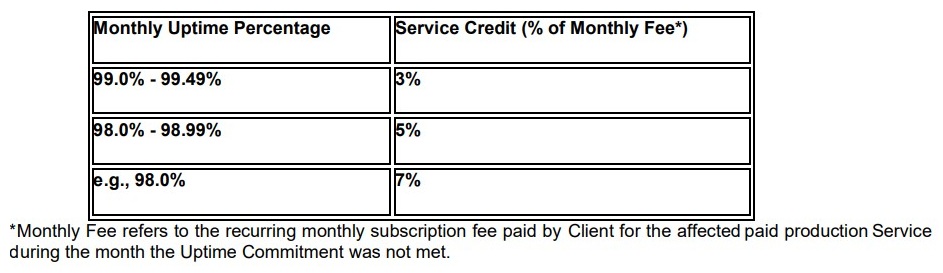
(a) Uptime Commitment. Epiq will use commercially reasonable efforts to make the paid production Services available with a Monthly Uptime Percentage of at least 99.5% (the “Uptime Commitment”).
(b) Uptime Service Credits. If the Monthly Uptime Percentage for paid production Services falls below the Uptime Commitment in any calendar month, Client may be eligible to receive a Service Credit as follows:
3. Maintenance.
(a) Scheduled Maintenance. Epiq will provide Client with at least five (5) business days’ prior notice of Scheduled Maintenance that is expected to cause Downtime. Scheduled Maintenance will typically be performed during off-peak hours (e.g., weekends or specific low-usage windows). Notice will include expected start time, duration, and scope.
(b) Emergency Maintenance. Epiq will provide notice as soon as reasonably practicable for Emergency Maintenance. Epiq will use reasonable efforts to minimize disruption caused by Emergency Maintenance. Downtime due to Emergency Maintenance necessitated by factors outside Epiq’s reasonable control may be classified as Excused Downtime.
4. Support and Incident Management.
(a) Support Availability. Epiq will provide technical support via designated Support Channels. Support for P1 and P2 Incidents for paid production Services is available 24 hours per day, 7 days per week, 365 days per year. Support for P3 and P4 Incidents for paid production Services is available during Business Hours. Support availability and response for Trial Services may be limited and is provided on a best-efforts basis or as otherwise specified by Epiq.
(b) Incident Reporting. Client shall report Incidents for all Services via the designated Support Channels, providing sufficient detail to allow Epiq to diagnose the issue.
(c) Incident Prioritization. Epiq will classify Incidents based on their business impact and urgency according to the following
Severity Levels:
Severity 1 P1 Critical: Production service down or severely impacted; routine operation impossible for multiple users; no acceptable workaround.
Severity 2 P2 High: Production service functioning but in a significantly degraded or restricted capacity; critical function impaired; difficult workaround.
Severity 3 P3 Medium: Minor functionality impacted, or performance degradation for some users, but overall operations continue; acceptable workaround.
Severity 4 P4 Low: Request for information, cosmetic issue, documentation error, minor functional issue with easy workaround; no business impact.
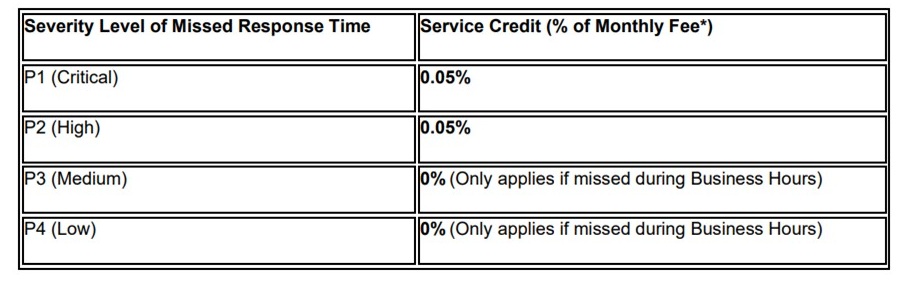
(d) Response Time Service Credits. If Epiq fails to meet a target Response Time for a P1 or P2 Incident for paid production Services, Client may be eligible to receive a Service Credit as follows.
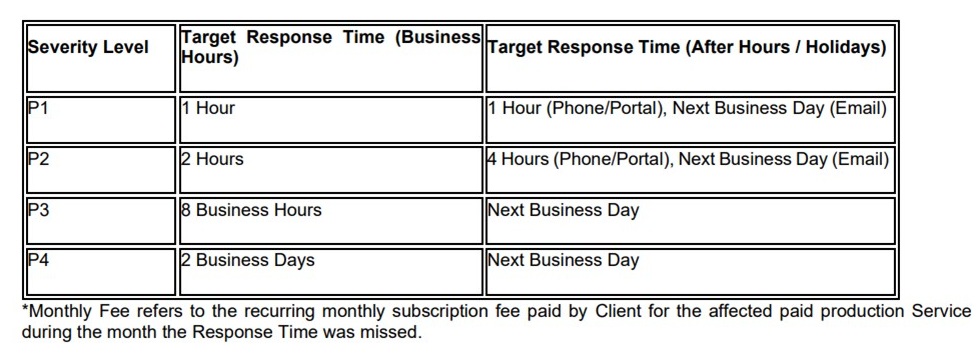
(e) Response Time Targets. Epiq will use commercially reasonable efforts to resolve Incidents for paid production Services or provide a functional workaround. Target resolution times are goals and depend on the complexity of the Incident:
(f) Escalation. If resolution progress stalls or Client is dissatisfied, Client may request escalation through their designated Epiq contact or the support team.
5. Service Credit Process and Limitations.
(a) Process. To receive a Service Credit, Client must submit a written request via Epiq Access within seven (7) calendar days of the Incident. Time is of the essence so any request received after that period will be denied. Epiq will investigate all Service Credit requests in good faith, and will use commercially reasonable efforts to finalize its review within fourteen (14) days of its receipt of the request. If Epiq validates the Service Credit request, then it will issue the Service Credit within two billing cycles following the month in which the request was submitted.
(b) Remedy. The Service Credits described in this SLA are Client’s sole and exclusive remedy for any failure by Epiq to meet the Uptime Commitment or Response Time targets specified herein for paid production Services. Service Credits are not available for Trial Services.
6. Client Responsibilities. Client agrees to: (a) Provide timely and accurate information when reporting Incidents; (b) cooperate reasonably with Epiq support personnel in diagnosing and resolving Incidents; (c) maintain its own systems, software, and network connectivity required to access the Services; and (d) use the Services in accordance with the Service Use Termsand Documentation.
7. Exclusions. This SLA and the service commitments set forth herein do not apply to any unavailability, performance degradation, or other issues: (a) caused by factors outside of Epiq’s reasonable control, including any Force Majeure Event or Internet access or related problems beyond the demarcation point of Epiq’s hosting environment; (b) that result from any actions or inactions of Client or any third party acting on Client’s behalf; (c) that result from Client’s equipment, software or other technology and/or third-party equipment, software or other technology (other than third-party equipment within Epiq’s direct control); (d) arising from Epiq’s suspension or termination of Client’s right to use the Services in accordance with the Service Use Terms; (e) Trial Services; or (f) resulting from Scheduled Maintenance or Emergency Maintenance performed in accordance with this SLA.
8. Modifications. Epiq reserves the right to modify this SLA from time to time, provided that any such modification will not materially degrade the service commitments during Client’s then-current Subscription Term for paid production Services. Epiq will provide at least thirty (30) days’ notice of any material changes to this SLA